VRChat is currently weathering a sizable backlash among users due to a controversial decision to not label AI-generated content.
The News
VRChat released a survey earlier this month asking users whether the social VR platform should in some way label AI-generated content as a way to fight back against low-quality slop.
The survey in question polled over 21,000 users. While results are no longer viewable online, Japanese outlet Automaton reports that around 95% of survey responders indicated they wanted VRChat to add an AI-generated content label, which would simplify filtering out AI content.
In a statement last week, the studio announced it won’t be implementing the change, maintaining the move may cause more harm than good:
“We’re not adding an ‘AI-generated’ label or AI filters. While we think some creators would honestly label their content, we think others would try to pass off generative or assisted work as completely authored by hand,” VRChat says. “Likewise, we could see this creating ‘sleuthing’ behavior, where folks would attempt to sniff out ‘AI’ content or might harass other creators, even if they are genuinely not using any AI tools in their workflow. We think this potentially creates negative behavior spirals we don’t want to encourage.”
Instead, the company has vowed to ban what it calls “AI-generated inaccurate thumbnails” used to advertise worlds. It’s also adding a way to like and dislike worlds, and a way to provide feedback on worlds within VRChat.
While an obligatory ‘AI content’ label is not longer in question, the studio says it’s still debating on whether it will offer an optional ‘Human-authored’ mark that creators can apply when publishing:
“We haven’t decided yet. If we do, it’d be optional, it’d only show on the world’s detail page, it wouldn’t affect discovery ranking, and a missing mark would never be an accusation or something you can report. We lean toward a ‘Human-authored’ mark over an ‘AI-generated’ label. As it stands, saying you used AI can feel like a confession.”
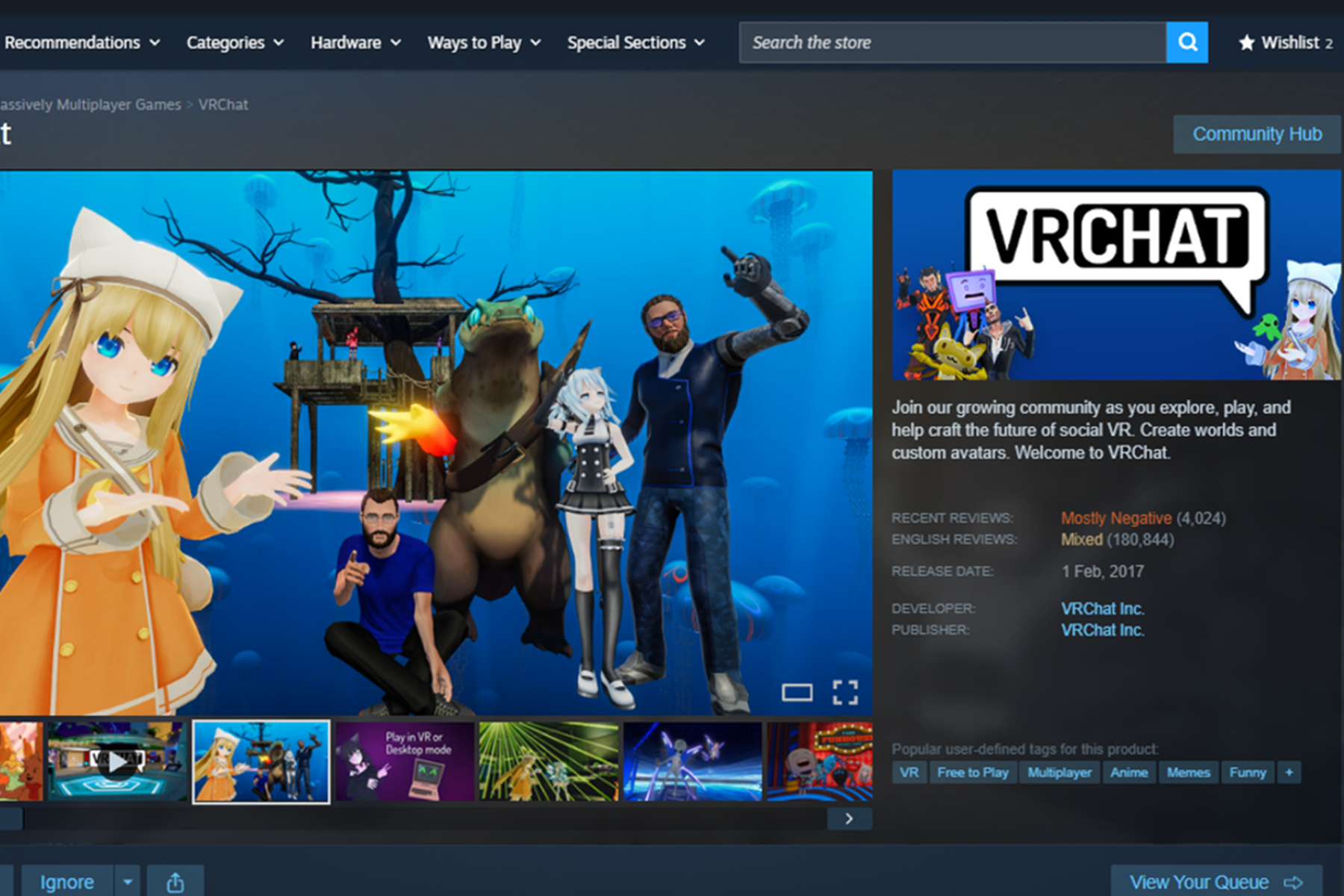
As a consequence, users have taken to Steam to ‘review bomb’ the app. At the time of this writing, VRChat now has a ‘Mostly Negative’ review rating of ~4,000 users, putting it at a 33% positive rating over the past 30 days. This has pushed its overall lifetime rating from ‘Mostly Positive’ to ‘Mixed’.
The current rash of negative reviews however pales in comparison to the studio’s 2022 decision to add anti-cheat software to prevent users from using modified versions of VRChat. That resulted in over 33,000 negative reviews in July 2022, according to SteamDB info, with ~8,000 more added in the following month. You can read more about that here.
My Take
Making content generation easier is a blessing and curse. Creatives can jump in and make something without needing all of the requisite knowledge of how to use Unity or Blender, which can result in something that otherwise wouldn’t exist. That also unfortunately means a rush of slop, AI-generated or otherwise, which VRChat users know has been an issue for a while now.
And VRChat’s creators are a big part of its identity. For many of the long-term users, it’s not just about what avatar you have or what world you built, but how you actually got those things.
For some, AI-generated content devalues this; it erodes what made the OG users attracted to the platform in the first place, because human-made things feel more earned, and the communities that grow around them feel more authentic.
For others, AI is simply one of many tools they use to create their art, and painting them with the same brush as someone who knowingly creates slop is unfair.
It’s not binary, although whatever your stance, world generation will eventually become even easier—Google’s Genie 4 is attempting just that. And VRChat is probably considering the long-term consequences of forming a stance on AI too early in its development, raising the question: how long will an ‘AI-generated content’ label really be relevant when AI is in everything?