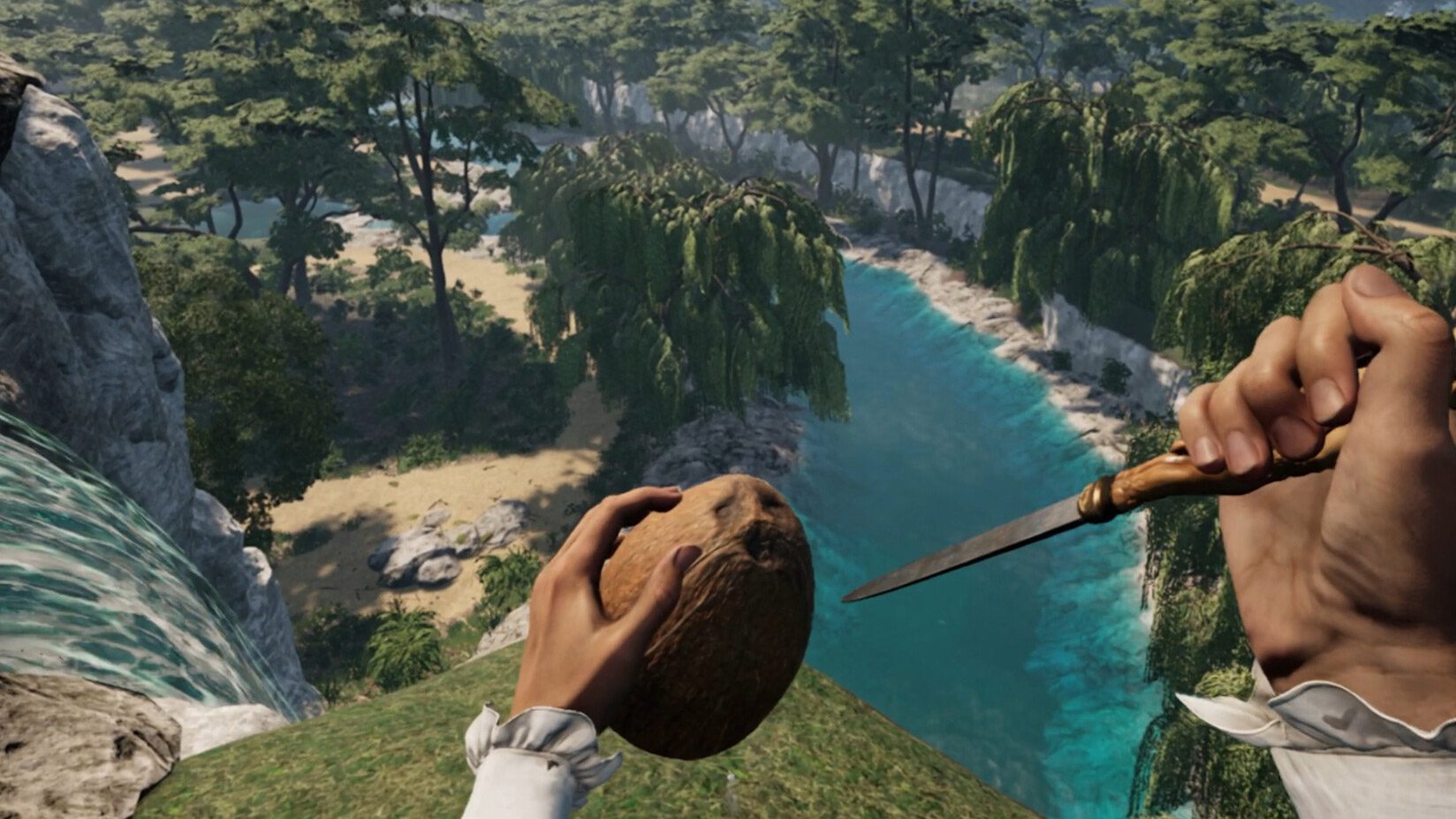
Every game is the result of thousands of choices. Some of these choices are creative, some technical, and some concern the scope and budget. After pouring sweat and tears into a project, there is nothing more heartbreaking for a game developer than realizing that some early choice made long ago was not the best one from the end user’s perspective. In this Guest Article VR developer Rein Zobel offers hard-won lessons in creating rich, immersive VR worlds.
Guest Article by Rein Zobel
Rein Zobel is the Creative Director and Co-founder of Maru VR, an Estonian studio specializing in immersive VR development. Since 2016, Maru VR has created more than 40 location-based VR projects across education, entertainment, and training. Their debut premium title, ‘Bootstrap Island‘, launched in Early Access in 2024 and is planned for full release in Q1 2026.

VR is a complicated market where success is hard-earned and failures are far too common. Sadly, most of us do not have the luxury of extensive prototyping and focus-group testing, so we often have to rely on our gut.
We got lucky in that regard. Before we started working on Bootstrap Island, a highly realistic VR survival game inspired by Robinson Crusoe, we spent years creating projects for various clients, from rescue training simulators to location-based tourism experiences. With over 40 completed projects, we had the opportunity to learn and test the medium through short, three to six month development cycles.
When we started the company in 2016, VR was new and client briefs were often vague. That gave us a lot of creative and technical freedom. We experimented with different tools and techniques, such as drone photogrammetry and branching narratives, and learned a lot from the process. Even more importantly, we received direct feedback from users, often observing them in real time as they played, with live commentary. This became our VR education, and we are more than happy to share some of the takeaways that guide our design principles today.
First, here’s a glimpse of what we’re building:
1. Meet Player Expectations

VR players come in with strong assumptions and extremely high expectations. They expect to be amazed from the moment they put on the headset. Unlike traditional games where players may ease in gradually, VR demands full attention and instant engagement. Putting on the headset, especially for the first time, is a source of excitement. It might even feel scary, as you are blocking out the real world and leaving yourself vulnerable to what is about to happen in this strange virtual domain.
The player’s mind and body are in the world from the very first second. If that first moment does not feel right, if movement feels off, visuals break immersion, or onboarding drags, the illusion collapses immediately. Long non-interactive intros, logo screens, and text instructions might be acceptable for mobile or PC games but kill excitement in VR.
The feedback loop in VR is also brutally honest. Players do not write long forum posts to explain what did not work; they flinch, sigh, or take off the headset.
That experience taught us to focus on onboarding first: teach by doing and show, do not tell. Frontloading the experience creates a strong first impression, and once that is achieved, players will be hungry for more.
2. Make Interactions Lifelike

Once players believe in the world the developers have created for them, they expect it to behave like the real one. When you pick up a rock, it should have weight. When you drop a torch, the fire should react.
If something looks interactable but is not, it feels like a bug, a break in reality. The founder of Valve, Gabe Newell, once called this a “narcissistic injury:” when the world ignores your actions, it hurts the player’s sense of agency in the game world.
In “Bootstrap Island”, this principle guided everything. We avoided fake interactions or UI shortcuts. If an object exists, it should have a purpose or reaction. The more consistent that logic becomes, the stronger the player’s belief in the world. The best moment in a VR game is when you get the idea to try something that does not seem obvious, and it actually works. That kind of emergent gameplay makes the world feel reactive and makes players feel smart for figuring out the rules without needing heavy-handed instructions.
3. Realism Works

One of the biggest lessons we carried over from our earlier location-based VR projects is that visual realism amplifies emotional realism.
We have seen people laugh, cry, or scream in fear during high-fidelity VR experiences. Some even tried to run away with the headset on, luckily without accident. These kinds of reactions are rarely triggered by stylized, low-resolution, or abstract environments. That is not to say stylization cannot work, but when aiming for presence, realism is a shortcut straight to the player’s subconscious.
High-quality textures, realistic lighting, correct scale, and natural perspective make a massive difference. The human brain wants to believe, and once it does, every emotion, including awe, fear, and triumph, becomes more intense. The promise of “you can do whatever you want in VR” works best when you provide a believable world to interact with.
4. UI Is the Enemy of Immersion

Menus, laser pointers, and floating buttons may be practical, but they do not belong in the fantasy of VR. They remind the player they are wearing a headset.
Our approach in “Bootstrap Island” was to eliminate abstraction wherever possible. Need to light a fire? Gather materials and do it by hand. Need to learn a mechanic? Experiment. The act of discovery becomes part of the story.
This approach not only deepens immersion but also makes learning the game fun. Mastery feels earned when the player’s hands, not menus, drive the experience. Use the world itself as your interface, replacing floating arrows with genuine curiosity and intuition. Reloading a weapon manually instead of pressing a single button is not a hindrance; it is the reason the player chose to play a VR game in the first place.
5. Audio Design Is Half the Experience

We often say that good sound design is 50 percent of a VR game, and we mean it literally.
In VR, audio is not just aesthetic, it is functional. Spatial sound helps players locate danger, follow clues, and understand what is happening outside their field of view. Every sound tells a story, the crack of branches nearby, the rumble of thunder, the whisper of wind through leaves.
Sound design serves as an invisible hand guiding the player. When a player hits a ripe coconut against sand or wood, it makes only a dull thump. But when hit against a rock, the coconut emits a juicy cracking sound. This feedback tells players they are making progress.
We also integrated voiceover into the game mechanics so that it feels like a narrator is telling the player’s story. This is a non-invasive way to teach gameplay while fitting naturally into the adventure-book tone, as if the narrator is describing the events as they happen.
Bringing It All Together

The five lessons, meeting expectations, lifelike interactions, realism, natural UI, and sound design, became the core pillars of “Bootstrap Island”. Together, they shaped a systemic, replayable, and emotionally grounded survival experience.
These principles may sound simple, but they emerged from years of iteration across dozens of projects. In VR, there is no one-size-fits-all solution, but these lessons consistently improved both immersion and player satisfaction. The fact that we chose to make a survival game is no accident either, as the shipwreck setting allows for complex interactions with life-or-death outcomes, giving dramatic context to every choice the player makes. Our love for survival stories and classic adventure novels played a part as well.
We learned that VR is a unique medium, not just a new platform for old design habits. It rewards creativity, honesty, and boldness, but punishes shortcuts instantly. Our goal was not only to make a game that works well in VR, but to create a game that demonstrates what the medium is meant to be.
If we treat VR as its own art form, respecting the senses it engages, we can build worlds that do not just entertain but convince. As storytellers, there is very little more we could ask for.
,